The tortoise and the hare: will China beat the US in the race back to the moon?
The rival superpowers are ramping up preparations for a crewed lunar landing nearly six decades after the first moon walk The world watched earlier this month as Nasa sent four astronauts around the moon – but to actually land on the surface the US is once again in a space race, this time with China. And China may well win. Both countries plan to build inhabited lunar bases – the first settlement on another celestial body – as well as searching for rare resources and using the deep space environ
Full article excerpt tap to expand
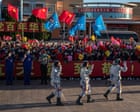
Astronauts wave during a departure ceremony before a rocket launch in 2021 in China, where the one-party system does not allow for changes in government to derail long-term objectives in space. Photograph: Roman Pilipey/EPAThe rival superpowers are ramping up preparations for a crewed lunar landing nearly six decades after the first moon walkBy Oliver Holmes, and Alastair McCready in Taipei. Graphics by Paul ScrutonSun 26 Apr 2026 02.00 EDTLast modified on Sun 26 Apr 2026 02.01 EDTSharePrefer the Guardian on GoogleThe world watched earlier this month as Nasa sent four astronauts around the moon – but to actually land on the surface the US is once again in a space race, this time with China. And China may well win.Both countries plan to build inhabited lunar bases – the first settlement on another celestial body – as well as searching for rare resources and using the deep space environment to test technology for future crewed missions to Mars.The well-funded China National Space Administration (CNSA) is pitted against the US’s National Aeronautics and Space Administration (Nasa).And while Nasa has an advantage from institutional knowledge of having already landed on the moon as part of its Apollo programme, it is attempting to return with just a fraction of the share of the national budget it had in the 1960s.The US space agency is also vulnerable to changes in government every four years, making it hard to stick to decade-long plans – something Chinese rocket engineers working in a one-party state are not affected by.To move ahead at speed, Nasa has outsourced critical mission components to private firms, including billionaire-led ventures aiming to capitalise on the burgeoning space economy. Elon Musk’s SpaceX and Jeff Bezos’s Blue Origin are both rushing to design and build lunar landers in time for test flights next year.Lunar landers from various producers Unlike the race to the moon between the Soviet Union and the US, the 21st-century competition is shaping up to be more like a marathon, with a gargantuan effort to launch multiple missions over many years.“What this is really illustrating is that it doesn’t matter who gets to the moon next. It matters who gets to the moon the next 10 times,” said Scott Manley, a Scottish astrophysicist and expert on rocket engineering. “The nation that keeps going is going to be the one that actually starts to win; starts to actually claim space. That’s critical.”With space being an area with opaque legal consensus, the first country to establish a presence on the resource-rich lunar surface will probably have a head start in defining the rules.Still, the first return crewed mission will no doubt be a major symbolic win, both domestically and as an expression of power overseas. This competitive element is regularly played up by Nasa, which has an interest in creating a sense of urgency to encourage Congress to fund it. The Nasa chief, Jared Isaacman, said this week that there was a global power competition for the “high ground of space”, adding: “When you do have a competition, you do not want to lose.”It is a tight race: Nasa plans to land in 2028, although it will possibly be delayed, and Beijing plans to land by 2030, but that could arrive sooner. “The difference between winning and losing will be measured in months not years,” said Isaacman.View image in fullscreenPeople watch as a rocket takes off from Hainan province, China, on 29 April 2021. Photograph: China Daily/ReutersChina’s human…
This excerpt is published under fair use for community discussion. Read the full article at the Guardian.
Discussion
More from the Guardian