The West Forgot How to Make Things. Now It's Forgetting How to Code
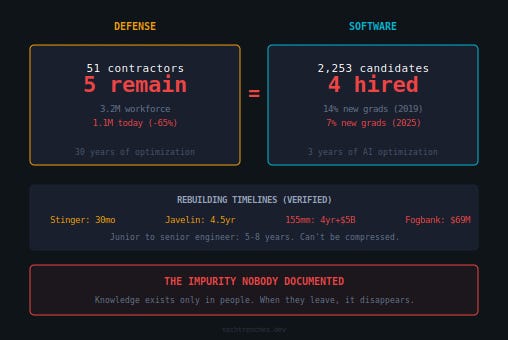
The West's defense industry lost critical manufacturing knowledge after decades of downsizing and reliance on cost-cutting, leading to severe delays in reactivating production during the Ukraine war. This same pattern is now repeating in software engineering, where reliance on AI threatens the development of deep technical expertise and institutional knowledge. Rebuilding lost capabilities takes years, not months, and money alone cannot accelerate the process. Without investing in human talent and hands-on experience, both industries risk collapse when crises demand resilient, knowledgeable workforces.
- ●Raytheon had to restart Stinger missile production using 40-year-old paper schematics and retired engineers because institutional knowledge was lost after two decades without production.
- ●Europe failed to meet its 2023 promise of one million artillery shells for Ukraine due to underreported capacity, outdated infrastructure, and halted domestic production of key components.
- ●The U.S. defense sector consolidated from 51 to 5 major contractors after 1993, creating fragile supply chains with single points of failure.
- ●A 2000 effort to reproduce the nuclear material Fogbank failed initially because the expertise existed only in retired workers, not in documentation.
- ●In software, AI use is reducing junior hiring and creating 'AI-mediated competence,' risking a future shortage of engineers with deep systems knowledge and debugging skills.
Full article excerpt tap to expand
The West Forgot How to Make Things. Now It’s Forgetting How to CodeDenis StetskovApr 21, 20261502738ShareIn 2023, Raytheon’s president stood at the Paris Air Show and described what it took to restart Stinger missile production. They brought back engineers in their 70s to teach younger workers how to build a missile from paper schematics drawn during the Carter administration. Test equipment had been sitting in warehouses for years. The nose cone still had to be attached by hand, exactly as it was forty years ago.The Pentagon hadn’t bought a new Stinger in twenty years. Then Russia invaded Ukraine, and suddenly everyone needed them. The production line was shut down. The electronics were obsolete. The seeker component was out of production. An order placed in May 2022 wouldn’t deliver until 2026. Four years. Not because of money. Because the people who knew how to build them retired a decade earlier and nobody replaced them.I run engineering teams in Ukraine. My people lived the other side of this equation. Not the factory floor. The receiving end. While Raytheon was struggling to restart production from forty-year-old blueprints, the US was shipping thousands of Stingers to Ukraine. RTX CEO Greg Hayes: ten months of war burned through thirteen years’ worth of Stinger production. I’ve seen this pattern before. It’s happening in my industry right now.A Million Shells Nobody Could MakeIn March 2023, the EU promised Ukraine one million artillery shells within twelve months. European production capacity sat at 230,000 shells per year. Ukraine was consuming 5,000 to 7,000 rounds per day. Anyone with a calculator could see this wouldn’t work.By the deadline, Europe delivered about half. Macron called the original promise reckless. An investigation by eleven media outlets across nine countries found actual production capacity was roughly one-third of official EU claims. The million-shell mark wasn’t hit until December 2024, nine months late.It wasn’t one bottleneck. It was all of them. France had halted domestic propellant production in 2007. Seventeen years of nothing. Europe’s single major TNT producer was in Poland. Germany had two days of ammunition stored. A Nammo plant in Denmark was shut down in 2020 and had to be restarted from scratch. The entire continent’s defense industry had been optimized for making small batches of expensive custom products. Nobody planned for volume. Nobody planned for crisis.The U.S. wasn’t much better. One plant in Scranton, one facility in Iowa for explosive fill, no domestic TNT production since 1986. Billions of investment later, production still hadn’t hit half the target.Consolidate or DieThis wasn’t an accident. In 1993, the Pentagon told defense CEOs to consolidate or die. Fifty-one major defense contractors collapsed into five. Tactical missile suppliers went from thirteen to three. Shipbuilders from eight to two. The workforce fell from 3.2 million to 1.1 million. A 65% cut.The ammunition supply chain had single points of failure everywhere. One manufacturer for 155mm shell casings, sitting in Coachella, California, on the San Andreas Fault. One facility in Canada for propellant charges. Optimized for minimum cost with zero margin for surge. On paper, efficient. In practice, one bad day away from collapse.When Knowledge Dies, It Stays DeadThen there’s Fogbank. A classified material used in nuclear warheads. Produced from 1975 to 1989, then the facility was shut down. When the government needed to…
This excerpt is published under fair use for community discussion. Read the full article at Techtrenches.
Discussion
More from Techtrenches