New robotic control software avoids jamming their joints
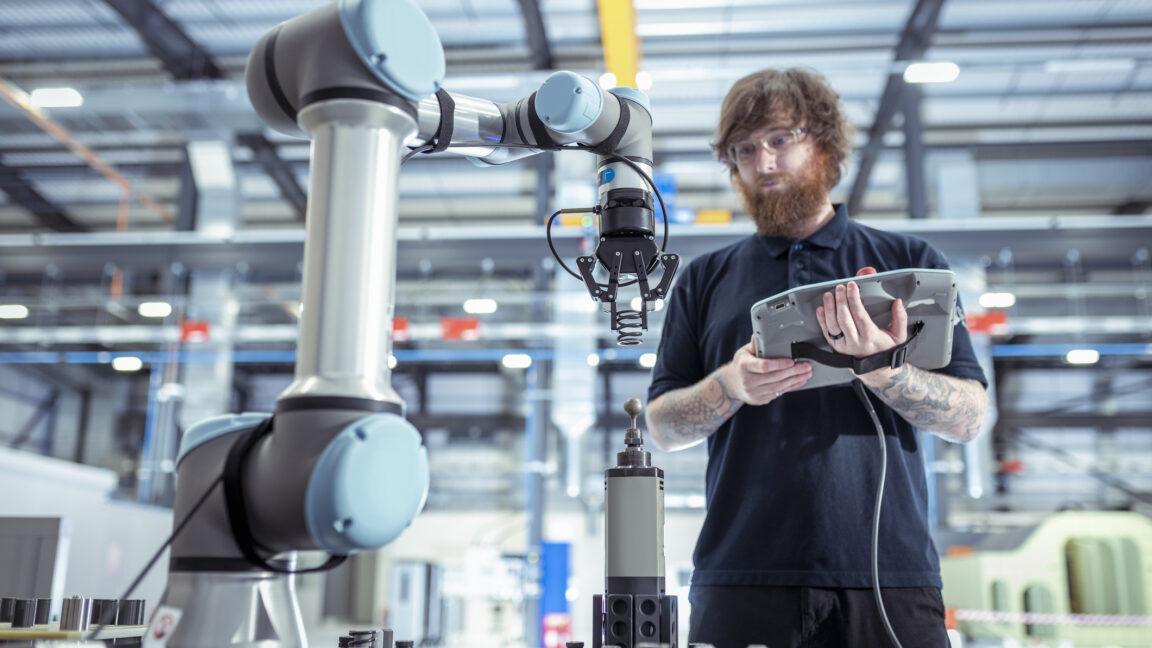
Software lets robots learn from each other even if they have different hardware.
Full article excerpt tap to expand
Know your limits New robotic control software avoids jamming their joints Software lets robots learn from each other even if they have different hardware. Jacek Krywko – Apr 26, 2026 7:09 am | 6 Credit: Monty Rakusen Credit: Monty Rakusen Text settings Story text Size Small Standard Large Width * Standard Wide Links Standard Orange * Subscribers only Learn more Minimize to nav Switching from one smartphone to another is mostly a smooth procedure. You log into your accounts and your apps, preferences, and contacts should sync to the new hardware. But in the world of robotics, swapping an old robotic arm for a newer model has meant setting everything up from scratch. To fix that, a team of researchers at the Swiss École Polytechnique Fédérale de Lausanne (EPFL) has developed what they call Kinematic Intelligence, a framework that makes switching robots work more like switching smartphones. They describe their system in a recent Science Robotics paper. Demonstrating skills For years, roboticists have been working on getting robots to learn from demonstration—teaching them new skills by showing them what to do, rather than writing lines of code. The idea is to remotely control or physically guide the robot’s arm to teach it a task like wiping a table, stacking boxes, or welding a car component. The problem is that most of these taught skills end up tied to the specific robot the training was done with. But robotics is advancing quickly. “The robots have different designs, and nowadays there are new designs being proposed—that brings its own set of challenges,” said Sthithpragya Gupta, a roboticist at EPFL and lead author of the study. If a new robot has slightly longer links, a different joint orientation, or a more complex configuration, that learned behavior instantly breaks and the new robot will likely flail, freeze, or crash if attempting it. “With new designs come different capabilities and constraints,” said Durgesh Haribhau Salunkhe, an EPFL roboticist and co-author of the study. “The problem is to adapt to these constraints and capabilities—to faithfully replicate the actions demonstrated by a human.” Today, making the leap from one robot body to another usually means starting from scratch and retraining the whole system. The danger zone When a robot moves through space to complete a task, it must constantly calculate how to bend its joints to keep its end-effector (a robotic equivalent of a hand) on the right path. The robot has to avoid hitting a physical limit, or worse, a singularity, which in robotics is a mathematical danger zone: a physical configuration where the robot’s joints align in such a way that it temporarily loses a degree of freedom. “In such positions, the robot’s motion may become unstable or [you] may lose control of the robot,” Gupta said. In human terms, it works roughly like locking the elbows as they get fully straightened when pushing something heavy, which makes the arms unable to perform side-to-side movements for a moment. Transferring skills from one robot to another is hard because differently structured robots usually have a different topology of singularities. When a robot’s algorithm blindly follows a path and hits a singularity, the math controlling its joints will fail. The robot might try to spin a joint at infinite speed, for instance, resulting in a sudden, unsafe movement. Gupta’s team solved this by giving the robots a deep, innate mathematical awareness of their own physical limitations.…
This excerpt is published under fair use for community discussion. Read the full article at Ars Technica - All content.
Discussion
More from Ars Technica - All content