This is who's developing Golden Dome's orbital interceptors—if they're ever built
"If boost-phase intercept from space is not affordable and scalable, we will not produce it."
Full article excerpt tap to expand
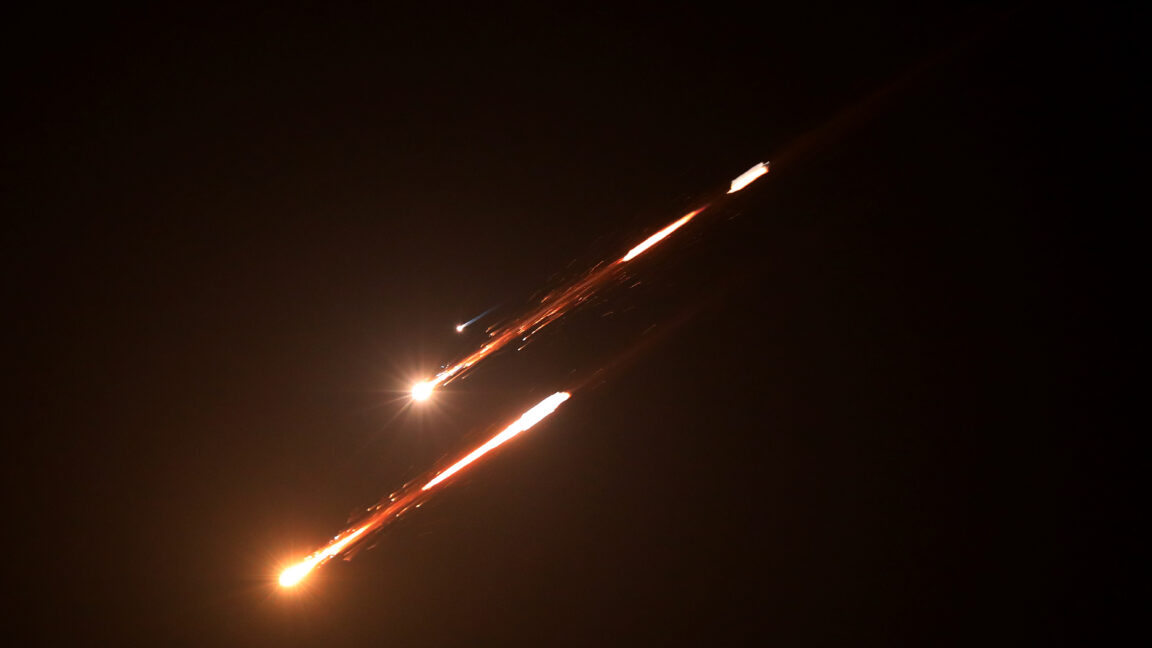
So many questions This is who’s developing Golden Dome’s orbital interceptors—if they’re ever built “If boost-phase intercept from space is not affordable and scalable, we will not produce it.” Stephen Clark – Apr 24, 2026 10:52 pm | 96 Missiles launched by Iran are seen in the skies over the West Bank on April 06, 2026. Credit: Wisam Hashlamoun/Anadolu via Getty Images Missiles launched by Iran are seen in the skies over the West Bank on April 06, 2026. Credit: Wisam Hashlamoun/Anadolu via Getty Images Text settings Story text Size Small Standard Large Width * Standard Wide Links Standard Orange * Subscribers only Learn more Minimize to nav The US Space Force released a list Friday of a dozen companies working on Space-Based Interceptors for the Pentagon’s Golden Dome initiative, a multilayer defense system to shield US territory from drones and ballistic, hypersonic, and cruise missile attacks. The roster of Golden Dome Space-Based Interceptor (SBI) contractors, some of which were previously reported, includes Anduril Industries, Booz Allen Hamilton, General Dynamics Mission Systems, GITAI USA, Lockheed Martin, Northrop Grumman, Quindar, Raytheon, Sci-Tec, SpaceX, True Anomaly, and Turion Space. The Space Force made 20 individual awards the 12 companies in late 2025 and early 2026 using an acquisition mechanism known as Other Transaction Authority, or OTA, agreements. OTAs allow the Pentagon to bypass federal acquisition regulations and cast a wide net to attract a larger number of potential contractors, and are especially useful for rapid prototyping. That is exactly what the Space Force wants to see with the first phase of the SBI program. The agreements have a combined value of up to $3.2 billion, and will capitalize on a mix of public and private investment to move SBIs closer to testing in low-Earth orbit. Officials have not released details of each company’s contribution, but the contractors come to the SBI program with different skill sets. The agreements are for early stage development and tech demos, not for full-scale production, which will come with a significantly higher price tag. “No additional information will be available at this time due to operational security requirements regarding the SBI program,” the Space Force said in a statement. The usual players Some of the companies on the list, such as SpaceX, Lockheed Martin, and Northrop Grumman, are well known in the space industry. They seem positioned to become lead or prime contractors. Others, such as Anduril and True Anomaly, are full-stack developers that are newer to the space industry but have lofty ambitions in the national security market. Quindar and SciTec, a subsidiary of Firefly Aerospace, have expertise in software. Turion develops space sensing technology, and GITAI USA had its start as an in-space robotics company. Booz Allen Hamilton is best known as an integrator and data services company serving the defense sector. General Dynamics provides “critical communications and electronics” for space missions, and was already selected to develop the ground control system for the military’s network of low-Earth orbit missile tracking and data connectivity satellites, according to its website. Raytheon, also known as RTX, builds missile warning sensors, ground control software (with a not-so-stellar recent track record), and manufactures small satellites through its subsidiary, Blue Canyon Technologies. “Adversary capabilities are advancing rapidly, and our…
This excerpt is published under fair use for community discussion. Read the full article at Ars Technica - All content.
Discussion
More from Ars Technica - All content